

Editor’s note: this is a guest post from Robb G (they/them), an activist based in Berkeley, CA. This is a long, detailed post we’re proud to showcase here as it breaks down a unique structure for buying property with your friends with a flatter power structure & mission-driven financing. Please note that this article was not written or approved by legal professionals, and should not be used as legal advice. Each individual situation is unique. The authors recommend consulting a lawyer to ensure any particular structure meets your own needs and the necessary legal requirements.

We were 7 folks in a rented coop in North Oakland, living together with a rare level of closeness for about 5 years. Our landlords, seeking to develop the lot, began plotting (by legal and non-legal means) to perform a constructive eviction, the term for when you are pushed out via a barrage of creative tactics that make durable tenancy, well, untenable.
We wanted a community that wouldn’t be threatened by the whims of strange and wealthy landlords, where we had complete control of our lifestyle, grounds, and building. We also were at places in our lives where we felt prepared to take on the significant labor of caring for a home long term.
This post explores the financial and legal model we used in late 2025 to purchase a home for our community. While it is similar to what was done by several long standing coops, this is the first public documentation of the model we are aware of.
There are many kinds of IRS-recognized non profits all with different codes under section 501 of the tax code, ranging from churches and charities (the famous 501c3) to unions and superPACs and frats and monastic orders where vows of poverty must be taken. We were tempted, but we didn’t go with that one.
We used 501c7 “Social Clubs” for the right balance of shared purpose, bureaucratic hurdles, and the ability to make equity, profiteering, and collapse less likely. More below!
Our Goals
We explored only flat models, where every resident is on equal legal footing as a tenant of the collective. No owners, no equity, no structural hierarchy of power (though emergent and implicit power cannot fully be avoided). We wanted a model where rents were as low as possible. To accomplish this, we explored only models where no one was profiting off the project since those profits flow from rents. We also wanted a house that would last forever and never again touch the speculative real estate market. We recognize that property ownership can be a rare tool of financial security, especially for marginalized communities who have historically been locked out of it. But at the scale of the Bay Area housing crisis, we see speculation and profit extraction as the dominant forces driving people out, and we wanted no part of that dynamic in our own home.
(Note that in this document, we are using coop to mean intentional community of folks living in one home together, not any of the legal or structural definitions of coop.)
In addition to a growing number of coops, many sororities and fraternities are 501c7s. We have not found any thorough explanation of this structure online or in books, and hope it can be helpful to others.
Sadly, nothing in this post really addresses the shittiest thing about Bay Area housing, that it is insanely expensive. Transitioning from a rental to an owned home is almost always going to cost more. The bay is among the many places where it is much cheaper to rent than to buy. According to this article, it is 2x the price to buy in Oakland vs renting. There are exceptions, sweetheart deals, donated down payments, etc, as well as the non-financial upshots of being landlord free, autonomy, permanence, and values alignment, but brace yourself- the math is often going to be sobering and frustrating.
There are two big parts of this post, one about creative financing and the other about the legal structure for owning and operating the house. You can mix and match, use our financing model and a different ownership model, or the opposite.
The Money Part
A mortgage is a loan secured by a house. If you stop paying, the lender forecloses: sells the property at auction to recover their money. Tenants likely can stay, and in CA even have an option to purchase. Banks issue mortgages constantly and profit enormously from it. Eww banks!
What most people don’t know is that banks have no special legal authority here. Anyone can issue a mortgage using the same standard contracts, and collect the same reliable income stream banks enjoy. Anyone, of course, with like $2 million in cash. Not so many people have that, but a group of 5-20 friends might.
Pooling resources through an LLC
By forming an LLC together, a group of people can pool their funds to issue a single private loan to the coop. The main advantage is security: the deed of trust on the property is held by the LLC, which means every investor in the group has the same level of protection if something goes wrong. The LLC also shields each member’s personal assets from liability, so if a dispute or default leads to legal action, it is directed at the entity rather than at individuals. The LLC structure also creates a clear framework for how decisions get made among the lenders. Let’s call it Friendly Loan Group LLC.
One important caveat: setting up this kind of arrangement involves complex securities law, and getting it wrong can have legal consequences. Investors will need a securities lawyer to structure it correctly before anyone puts money in.
Why coops need creative loans
Banks almost always refuse to loan to housing cooperatives, not because coops are inherently risky, but because their loan products simply aren’t designed for anything interesting or complex (more on that in Phil’s post here). Despite having strong, stable communities behind them and enough money to pay the loan, banks usually won’t bite unless the residents can show a more ‘normal’ front, usually a single person or a couple to hold a mortgage— but this introduces additional power dynamics and hierarchy that were not otherwise present in the community. We reached out to 10 institutions, both smaller values-aligned banks, credit unions, and big banks. One passing thought, we never reached out to sorority/fraternitiy specialist lenders, these seem to exist, and it might be worth a shot!
A coop with ~5 or more residents is particularly attractive for a ‘mortgage’ from Friendly Loan Group LLC. Mortgage payments are shared across many people, so one member losing a job doesn’t threaten the whole payment. Single family mortgages are riskier in many ways: a small family can lose financial stability more easily than a group of 10.
Why people should consider investing in coops
If you’re 25 to 45, you probably have friends hoping to retire in 20 to 30 years. Most retirement savings flow into 401(k)s, stock market accounts returning historically 6% to 8% annually, but tied to corporate profits and market swings that many find both unpredictable and unethical. I spent a long time looking for the least-unethical stock bundle, and have not been impressed with SPYX, ETHO, Or JSTC, 3 “ethical social justice” funds that invest in still kinda evil companies. Making things worse, they have returns that are as much as 5% less than the standard stock products that include weapons manufacturers and oil companies.
A private mortgage offers comparable returns, historically 5% to 12%, with a meaningful difference: you receive monthly payments throughout the life of the loan. Your money is gradually coming back to you the whole time in monthly payments from the borrower. If the loan group wants to expand and fund additional coops, the more diversified its portfolio becomes. Coops for everyone!
Your Friendly Loan Group LLC could negotiate the interest rate directly with the coop once contributors are gathered. The IRS establishes a federal minimum interest rate based on the market, currently around 4.5% (Look up this month’s min rate here under Long Term AFR monthly compounding) but above that floor the rate is whatever both parties agree is fair. The best foundation loans run about 1% above market rate (2026 6.5%+1%=7.5%), since these foundations are typically getting a bank loan (2026 6.5%) and then up-charging the borrower to cover admin and risk. Your Friendly Loan Group LLC could choose whatever works for everyone. We negotiated ours at 4.5%, but our Friendly Loan Group LLC was funded by a single wealthy individual instead of by a large group of friends. This is obviously not a commonly available option, and the structure would work just as well with a larger group of contributors as well.
Fundraising sounds impossible, and while it is surely difficult, know that another Bay Area coop was recently able to raise over a million dollars in short term loans to save a coop from foreclosure. They ended up not going forward with the project, but it was an encouraging surprise to all how many community members had deep commitments to the cause of community housing and somewhat secret money available to invest in a values aligned, somewhat secure project. Those loans were structured similar to a mortgage with a balloon payment to return all loans upon refinancing the home with a traditional mortgage.
If a supporter wants to invest in the house, but has retirement funds currently in a traditional IRA, Roth IRA, 401k, or 403b, they may be able to roll it into a “self-directed IRA” and use it to fund a private mortgage loan to the coop, as long as they are not a resident, the spouse, parent, or child of a resident. The rules here are specific, so anyone considering this path should talk to a tax advisor.
Creative Loan Terms
Unlike a bank, your Friendly Loan Group LLC can do creative things. In our case we structured the loan payments (which are normally fixed) to increase 2% annually to keep costs low initially and eventually to track with inflation. Our mortgage payments are $5700/mo in 2026, but will be $7570 in 2040. We couldn’t have afforded our rents in year 1 if we hadn’t structured the loan to have these annual payment escalations. Unlike a bank, we also omitted loan fees. A traditional mortgage lender will typically charge several thousand dollars in loan fees simply to issue a mortgage.
Another upside: when bidding on a house, it is possible the seller will look favorably on your offer having a private mortgage, since your Friendly Loan Group LLC will often not require the standard banking hurdles that can complicate deals, such as mandatory appraisals, underwriting requirements around credit scores and debt-to-income ratios, property condition requirements, and a closing timeline controlled by the bank’s processing speed. This makes your offer more like cash.
Surely there are risks
If the coop defaults, recovering Friendly Loan Group LLC’s money means foreclosure, a legal process that is complex, costly, and hard on everyone. Property values fluctuate, and no investment is guaranteed. Bay Area real estate has proven remarkably resilient, and a large coop spreads the risk considerably, but those risks are real. They’re also the same risks banks accept every day and profit from enormously. The difference is that your returns go to people you know, financing housing you believe in, rather than to shareholders. The stock market also has risks. This is not financial advice, but it worked for us and we think it may be a good fit for a lot of coops seeking to end their relationships with landlords.
What about once the house is paid off?
Great question! It is possible the house will never get paid off, we may have to refinance for construction costs or earthquake damage or something about the apocalypse ending the world before 2056. But if it does get paid off, one option would be to drop everyone’s rents by about half, as that is the portion that goes to the mortgage. This would allow for folks to work less, redistribute more money to causes they care about, and for vacant rooms to be filled by lower-income folks. Another idea would be to funnel that money into financing another coop, or expanding the current one. We are leaving that up to the cyborg revolutionaries who will live here in 2055.
What if we want to move out? Or sell the house?
It’s true you’re not building equity and you can’t choose to sell the house yourself and recoup what you’ve invested in it. But instead you’re operating through a non-profit structure that is building community equity and community resilience. This can serve as a model for how we relate to land and so-called property in different ways. Some folks are still beholden to engaging in the speculative system because they don’t have other forms of savings or security, but it’s our hope that models like this could provide alternative forms of security that mean we are not as dependent on extractive speculation.
The Legal Structure Part
Someone or something has to own the building and land, and that someone usually is a landlord, a speculator, or a community who eventually needs their money back. But it turns out non profits can also own land, and cannot themselves be owned by anyone. Pretty cool!
Why we didn’t go with 501c3(math warning)
We are not lawyers, but this is our impression of the rules after we talked to our lawyer.
One way is to have the home owned by a 501c3 non profit, technically a charity.
This has a lot of advantages, including the most widely known, that contributions are tax deductible. Others are surprising: there are discounts on insurance, and some financial institutions only work with c3s. However, a 501c3 housing cooperative must meet strict IRS income requirements that make this classification difficult for any group and impossible for mixed income groups. (Math Warning!) Simplified a little, at least 75% of “units” (bedrooms in the case of a coop) have to be occupied by “low-income” households (bay area single person 2026 $87,550), with 20% at very low-income (bay area $55,950). People who begin to earn more after moving in may stay indefinitely, but this can limit the coop to only being able to accept low-income or very-low income applicants.
Rents charged to residents have to be affordable, which sadly means they may be too low for the house to pay its bills. To keep rent affordable, the IRS expects rent to be capped at 30% of the low-income threshold (~$2,190/month per person in the bay) but Bay Area houses cost over $200k per bedroom to buy, meaning mortgage payments alone (ignoring utilities, maintenance, etc) on a the house can exceed what you’re legally allowed to charge. (See Revenue Procedure 96-32 for details.) For many houses on the open market, one would have to recruit people who cannot afford to live in the house, and it would be illegal to charge what the project would need to pay its bills.
The whole thing seemed too limiting and complex to us especially since our high mortgage payments wouldn’t allow us to charge affordable rents for low income residents.
The rule of thumb in the coop world if you want to start an affordable 501c3 coop is that you need to find a house for sale for $100k per bedroom or less- IE $1m for a 10 bedroom- in order for your monthly costs to stay under the IRS rent cap and for your resident pool to be able to afford living there. In the Bay Area, where buildings routinely cost two to three times that per room, it simply can’t work unless you have an off-market sale or a donation. If a seller is willing to accept less than fair market value, they can get a giant tax deduction equal to the difference between the sales price and the fair market value, as determined by a licensed appraiser. This is called a bargain sale and it can help a 501c3 coop negotiate a good price for a property. One other cool thing about a 501c3 is that donations are tax deductible for the donor. Only donations (not rent) are deductible, and only 501c3s have this perk.
Even if you could make the numbers work, the compliance burden is a lot for a small residential coop: annual income verification for every resident, public financial filings, governing documents that frame the house primarily as a poverty relief program, and strict limits on how many c3 board members can simultaneously be residents (unless 100% are low income) prevents full self governance for c3s. And if you want the dream of property tax exemption in California (can save ~$20k+/year!), the bar is even higher and nearly impossible to clear in practice. (Basically either the house needs to receive financing from a government body or 90% of all units have to be “lower income,” meaning beneath 80% area median income in your area. And rent has to be no more than 30% of the wages of a household making 60% Mean Income). Property tax exemptions vary state by state, so be sure to check your state’s rules.
Many 501c3 houses were founded when housing prices were less extortionate. A c3 structure has worked for many houses in the Bay Area when they were able to acquire the house before housing prices got so high or if they can acquire the house below fair market value.
Zooming out, one of the big differences between the 501c7 and a 501c3 is that the 501c7 is explicitly designed to be controlled by and benefit its members, whereas the 501c3 has rules about private benefit that mean those who are receiving a benefit must be separated from those who are in control of the organization. With the c7, the resources are put in the center and governed together.
Why we didn’t go with LLC
We also considered using an LLC to hold the house, and ruled it out fast. Phil has a great write up of the perks here! Under California law, LLC members have an inalienable right to their share of profits, which means any clause we wrote banning cash-outs, equity stakes, or selling the building would have been legally unenforceable. Someone could have moved in, sat on their membership interest for a few years, and walked out with a claim on the building’s appreciated value. On top of that, an LLC pays income tax on its assets in ways a nonprofit does not. There are public benefit modifications that can be added to LLCs, but they seemed like a bandaid—the whole point was to take the house permanently off the speculative market, and the LLC structure makes that promise impossible to keep.
Why we didn’t go with TIC, etc
A Tenancy in Common (TIC) gives each co-owner a fractional share of the property they can sell, borrow against, or force into a court-ordered sale through a ‘partition action’ at any time, meaning one person having a financial crisis or a change of heart can blow up the entire living situation for everyone else. Unlike a nonprofit structure, a TIC has no mechanism to prevent someone from selling their share to a stranger or an investor, and nothing stops a majority of owners from making decisions that benefit themselves at the expense of the others. With more than two or three people involved, the coordination required to get unanimous or majority agreement on repairs, refinancing, new members, or anything else becomes a governance nightmare with no real enforcement tools beyond going to court, yuck.
Because of our goals, we also ruled out Limited Equity Housing Cooperatives (LEHC), Market Rate Housing Cooperatives, Permanent Real Estate Co-Op, and being owned by a single individual or couple.
Why we did go with a 501c7 “social club”
The Greenhouse is owned by a 501c7 nonprofit called Jurisdiction Syndicate (JDXN), which means the home belongs to no individual and earns profit for no one.
The structure holds the land for the common purpose of the community, permanently removing it from the speculative market and keeping it available for values-aligned people to live in, for generations.
A 501c7 is a social club designation under IRS rules, and it turns out to be a surprisingly good fit for cooperative households where people live together for a shared purpose. Note that just living in a house together isn't enough to be a c7— there needs to be an underlying exempt purpose. This is the most important part to get right and a lawyer can help to evaluate whether the shared purpose meets the requirements for the c7 structure. In the case of JDXN, our shared purpose is based on commoning and governance practices.
The 501c7 structure allows a group of people to pool resources, govern themselves, and steward shared property without triggering the legal and tax complications that come with other nonprofit structures. While donations to a 501c7 are not tax deductible, a c7 has the tax benefit of its income not being taxed, unlike LLCs (see Downside #2 in Phil’s “FriendLLC” article).
We could have started our own c7 instead of working with an existing one, but we were in a hurry as our previous landlord was trying to push us out of our previous coop, and we wanted to work with values-aligned communards with relevant experience. We also think that having some degree of control held by values-aligned non-residents may make future crises easier to navigate. JDXN was founded to support coops after encountering obstacles both within the for-profit world of LLCs etc as well as barriers within the non-profit charity (501c3) models for coop ownership. In our case, as of writing JDXN charges $50 per person per month to defray their administration costs.
Residents of The Greenhouse become members of JDXN, and a small board, consisting of ~3 outside trusted community members and ~2 residents provides a balance of autonomy and oversight. The board could also be made entirely of residents if desired. Having some non-resident board members may be helpful for dispute resolution or to ensure decisions like rent setting and maintenance are made wisely.
There is no landlord to answer to, no investor to appease, and no one skimming profit off your rent. What there is instead is responsibility: the residents do the work that landlords usually do, and that is very much the point.
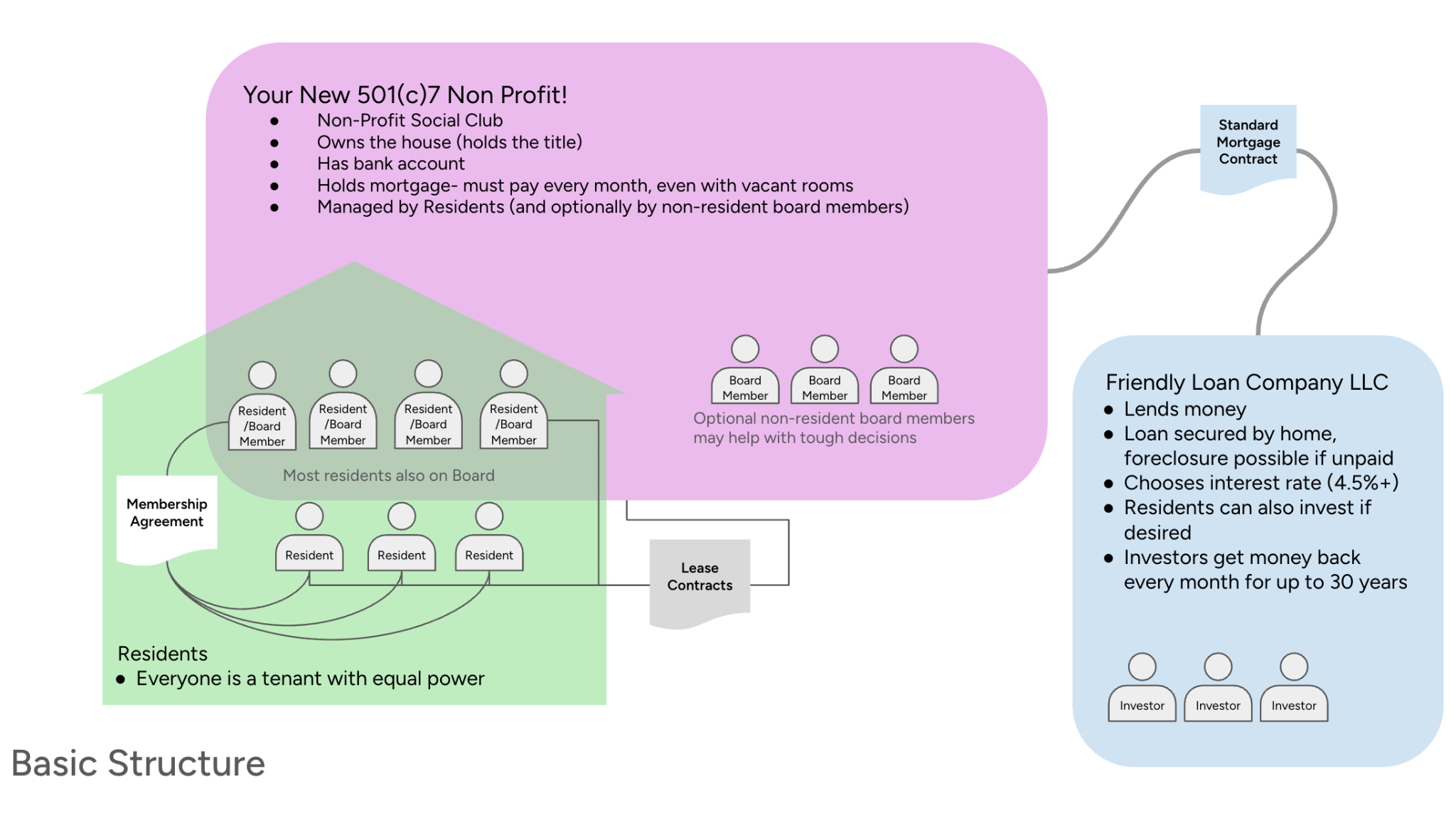
The above is the simplest version of what we are proposing.
We are not the first 501c7 coop
At the time of writing, our home has existed for only 6 months.
In writing this, I wanted to prove to myself and to the reader that this is a durable structure, so I had several long calls with longer-running 501c7 houses. As far as I know this article is the only documentation of using a c7 for a housing coop.
Andrea from a co-op in Berkeley (8-people, converted to 501c7 in 2006 after 30 years as a coop):
“Don’t be afraid of the bureaucracy! Our legal structure exists to uphold our values The idea was long term legacy, no concentrated power, and that no one profit from this home. Documents can seem burdensome and written in a strange language, but they are written to serve you, they set the grounds for understanding and community.”
Hannah from a commune in Los Angeles (10-people, run as 501c7 since 2019, but founded more than 50 years ago):
“The commune is a nonprofit - no one owns the house, and members have a right to live here as long as they’re in good standing. The 501c7 structure has made tough conflicts easier to resolve, and kept individuals from destabilizing the community for their own benefit when their lives or values change.”
What about change?
We chose the 501c7 structure because it gave us a member-governed framework while allowing us to layer in hard contractual guardrails against future profiteering. Through a recorded deed restriction and purchase option agreement, the residents hold a 99-year option to transfer the house into a new non-profit at the cost of whatever remains on the loan - not market value. The property can only be transferred to another nonprofit entity. Because these restrictions run with the land (Cal. Civ. Code §1461), they bind future owners regardless of changes in membership or board composition. Transfers would trigger transfer tax, a thing we’d like to avoid.
The structure keeps the door open for the community to evolve.
Unexpected Hurdles
We always thought that not having a landlord would be 100% relief. No more weird looming presence with unearned power to end the community you put everything into shepherding. No more fear that your rent would double because your landlord thought of a larger number. No more having to tiptoe around the strange egos and stranger ideas of the landlord class.
We all held the common ideology that many landlords do not work, they siphon money from those who do. While most of the greenhouse residents still believe that big landlords do not labor enough in the general case to earn their (often but not always) exorbitant sums of money, we were frustrated and humbled to learn how much work, bureaucratic, logistical, physical work it is to manage a property - especially in the first year or so. Bookkeeping (hire a professional, and right away!) learning legal structures, doing home improvements, deciding which to do and not to do, managing lovely contractors, managing not-so-loverly roofing bosses, removing invasive plants, having to figure out what lease language is actually important to the longevity of the project and what is zero-trust landlordy garbage.
More than anything else, it was hard to lose a designated opponent, the eternal antagonist who could stifle our dreams and give us something to push against. Suddenly having full control is overwhelming. The project being eternal raises the stakes- it can feel like any decision has vast and far-reaching consequences. Consensus on the quantity of early decisions our house had to make proved exhausting. Burnout was rampant, and it took us 6 months to calm down and get a sense of what was urgent, what folks cared about, and how to live without the pseudo-parental guardrails of living in someone else’s house.
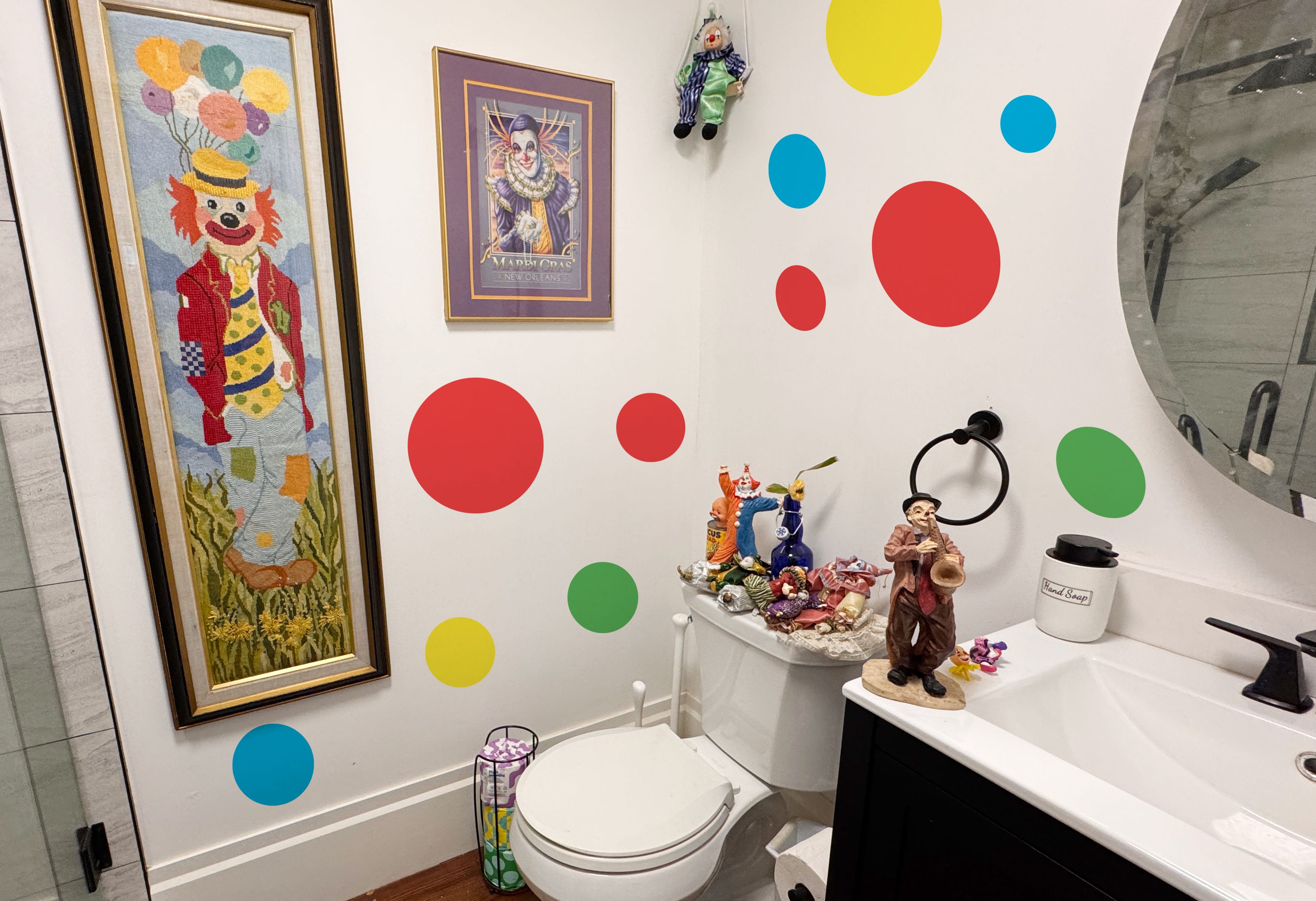
Right now, we feel good. We have figured out how to move as if we have a lifetime to shape the project, to know that our work will affect residents for decades or generations. There is a joy in maintaining a garden that we know won’t be taken from us, from cleaning out gutters for ourselves, to trusting the process for which and how many clown paintings go in the clown bathroom (see below), for slowly convincing one’s roommates that a climbing net would, in fact, improve the living room. For us, the landlord-withdrawal symptoms have been worth it for landlord freedom, but honestly, I still call them sometimes for contractor recommendations.
Further Reading
Most of us read Creating a Life Together by Diana Leafe Christian. It is very detailed and outlined a lot of the social and legal obstacles we faced. I would for sure recommend it get read by at least two members of your team. It does not explore 501c7s, but has a lot to say about 501c3s and even 501(d) monastic orders. I recommend it highly .
Our friend West wrote this about 501c3 housing status. https://resources.uwcc.wisc.edu/housing/501c3_Housing_Coops_2022.pdf
We highly recommend our lawyer, Jesse Palmer: https://jessepalmer.wordpress.com/attorney/
He has helped set up more than 5 501c7 coops (starting in 2006!) and it is his frequent recommendation. He also has significant experience with 501c3 houses and land trusts.
JDXN had their own lawyers through this process, because until the house was purchased we were not the same entity. Mill Law Center specializes in working with the non profit sector and also has extensive experience in helping idealistic groups work out non traditional ideas. They were a great support for this project as well!

Wow this awesome and glad it worked out. Nice to know about c7s. Curious to see how the community evolves.
I'm tearing up, this set of information is such a labor of love and a gift! I'm aiming to navigate the jump from a house I bought with my brother and his wife to a future property where there are more people involved who are not relatives, and I'd started despairing about what structure could possibly make any sense. I've heard so many people throw around the idea of forming an LLC, but could never understand how that would actually help. This is such a clear and helpful explanation, I feel like my brain is evolving! Thank you thank you thank you!!!