
How to kill a community (before it even starts)
Know what game you are playing

Five groups set out to start an ambitious coliving community. Four of them fail. One succeeds.
What was the difference?
With no other information, here would be my guess: The group that succeeded had one or two people willing to decide on behalf of the group. The four that failed tried to reach consensus within the group.
That’s it. That’s the whole post. But let me explain why, because it took me years and a seeing a couple hundred groups to actually believe it.
The Great Defection
We’ve watched hundreds of groups try to form coliving or cohousing communities. And over the years we’ve gotten very good at predicting who’s going to make it and who’s going to evaporate.
Here’s the counterintuitive part: the larger groups — the ones who, in theory, are better placed to actually buy a property and fill it — are the ones who drop like flies.
The pattern goes like this:
Person A: Let’s do this.
Person B: Let’s do this.
Person C: Let’s do this.
Person D: I don’t like the kitchen layout
And just like that, it’s dead.
The unspoken assumption buried in Person D’s objection is that somewhere out there is an identical place — same price, same location, same everyone-already-agreed-on-it — except with better kitchen layout.
Sorry. There isn’t.
So the energy evaporates, the group thread goes quiet, and everyone ends up living alone in their own apartments. I call this the Great Defection, and it happens constantly.
Here’s what’s actually being traded away in that exchange. Person D thinks they’re weighing “this kitchen layout” against “better kitchen layout.” They’re not. They’re weighing “a community of people I love living nearby” against “no community at all.” The kitchen layout is a rounding error. They just can’t see it yet.
There is no Venn diagram
Let me say the thing plainly, because it’s the load-bearing idea of this entire post:
There is no Venn diagram of four-plus people’s individual preferences. That overlapping sweet spot in the middle? It doesn’t exist. Not for a house. Not for a neighborhood. Not for anything that has to satisfy walk-in closets, nearby parks, school districts, garage space, and somebody’s feelings about open-plan kitchens all at once.
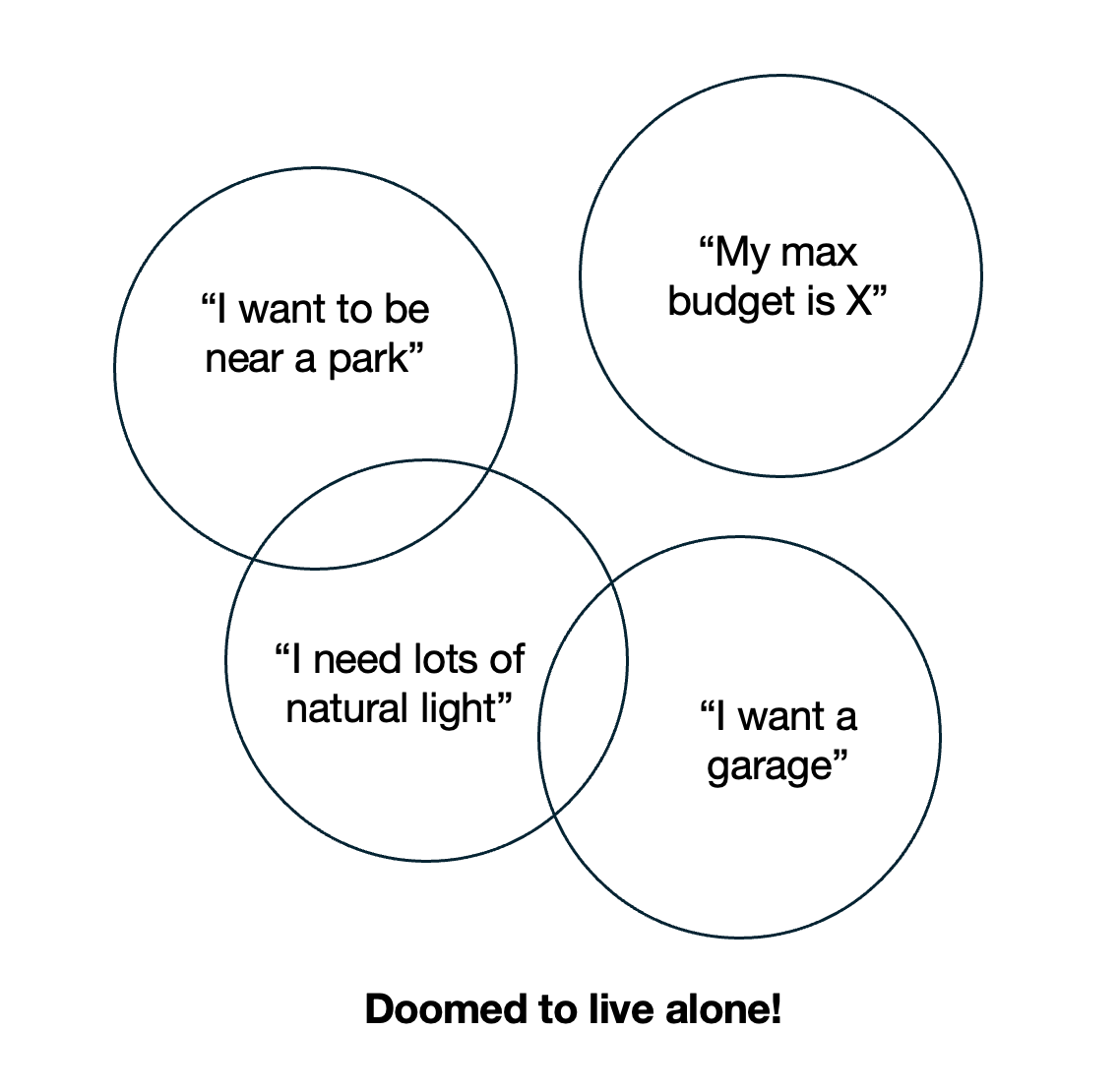
Somebody is not getting their personal preference. That’s not a bug in your group. That’s just math. Which means there are only ever two real options: people get on board despite their preferences, or you eject them. There’s no third door where everyone’s wish list is quietly satisfied.
Let’s do the math
I’m serious about the “it’s just math” thing, so let me show my work.
Say you’ve got four decision-makers trying to reach consensus. And say that, for any given person, one in five homes on the market actually works for them. (Generous, honestly.)
For a home to work for all four people, you need the one-in-five to hit for each of them, independently:
⅕ × ⅕ × ⅕ × ⅕ = 1 in 625
So you’d need to look at roughly 625 properties to find a single one that satisfies all four people.
Now ask yourself: are there 625 properties on the market in your city that can even accommodate a multi-household living arrangement?
Absolutely not. You can count the spaces that work well for “multiplayer housing” in your city now on your two hands.
If you want a single-family home, go ahead and be picky — you’ve got a thousand options. If you want to build something with other people, you simply cannot be that picky. The numbers don’t allow it.
Don’t play someone else’s game
There are two completely different games you can play when you go looking for a place to live.
The default game: You scroll through a thousand single-family homes and apartments and pick the one that best fits your preferences. Spanish-style architecture — check. Walk-in closet — check. Good light, right neighborhood, second bathroom — check, check, check. This game works. There are a thousand options and you can afford to be picky.
The Supernuclear game: You find a space that works well for a collective. It might be short on the Spanish architecture and the walk-in closets. But it makes up for all of that with one giant amenity that none of the thousand picture-perfect single-family homes can offer: a community of people you love, living right there with you.
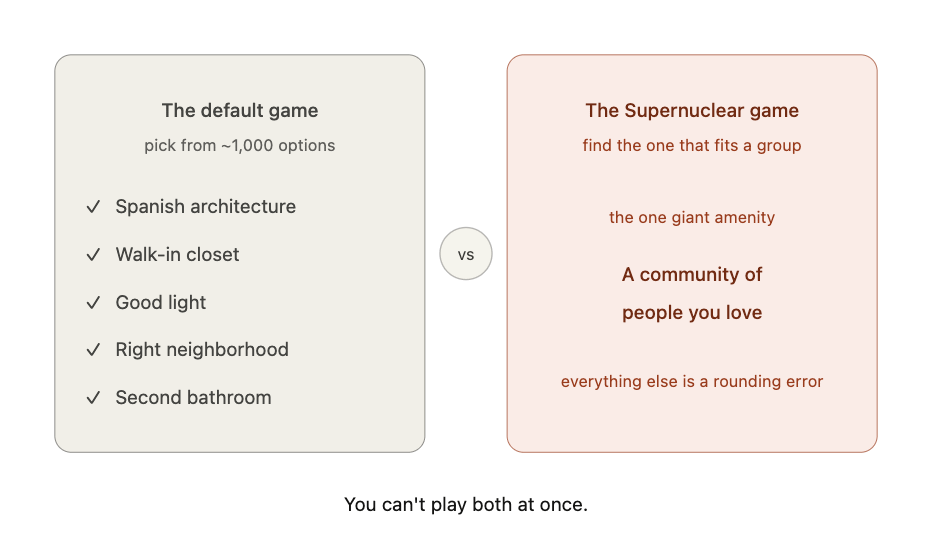
Here’s the trap. You cannot play both games at once.
If you bring default-game pickiness to the Supernuclear game, you will lose. You’ll torpedo the one option that has the giant amenity because it failed some checklist item that only matters in the other game.
So how does this actually happen?
If consensus is mathematically doomed, how does any coliving community ever get built?
Like this: one or two people find a place that works for them, commit to it, and trust that it’ll work for others once it actually exists.
I’ll tell on my own friend group. A decent chunk of them were “nahhh, Oakland” before we bought Radish. Not their preferred city.
Then Radish existed. They visited. They felt it. And they flipped — now they live with us.
Here’s the thing that keeps me up at night a little: had those friends been voting parties in the original decision, there would be no Radish. Their entirely reasonable preferences would have killed it before it started. The community that they now love and live in only exists because they didn’t get a vote at the founding.
Video: Kristen and I describe the 5 most common mistakes we see people make when trying to live near friends to potential Radish buyers
So who gets to decide?
The people who take on the burden.
The decision-makers are the ones with skin in the game. They’re signing up for more effort and more risk than anyone else. That’s what earns the decision. The burden and the decision come as a package.
This does not mean the deciders have to front all the money. It means they get to define the terms on which everyone else comes in. Something like: “We’re looking for three founding residents to join us. Each puts in $100k toward the purchase” — or “helps fund $5k of the security deposit.” The deciders set the shape of the thing. Everyone else opts into a shape that already exists.
“But won’t that create an unequal dynamic?”
Yes. It will. The founders will probably hold an elevated stature in the group. Let’s not pretend otherwise.
This was our number one fear going into Radish. We were terrified of accidentally building a little hierarchy, of being the people who “owned” the vibe.
And it turned out to be a non-issue.
Here’s what we learned: people mostly just want a good place to live, with good people, at a fair deal. And — this surprised me — they actively like knowing the buck stops with someone. They like that when something breaks or a hard call has to be made, there’s a clear answer to “who decides?” The ambiguity is what people hate. Not the hierarchy.
—
So if you’re sitting in a group thread right now with five enthusiastic people and a slowly dying dream, here’s my advice: stop trying to find the place that works for everyone. It doesn’t exist.
Instead, figure out who’s willing to carry the burden — and let them decide
Tour de force. It’s the same on a fishing boat . Always has been the case.
I think your conclusion is correct, and your napkin arithmetic is illustrative, but it's worth* noting it assumes total lack of correlation between preferences, whereas your diagram represents a scenario I suspect to be more representative of reality where certain preferences correlate while others anticorrelate, so the actual difficulty of finding a house that meets all preferences in a scenario where each person only likes 1/5 houses on the market would vary wildly.
*Ok, ok. Maybe it's not. Your pedantic mileage may vary.